Probability, fairness, and life
A Mathematical Reading of the Code of Many Colors
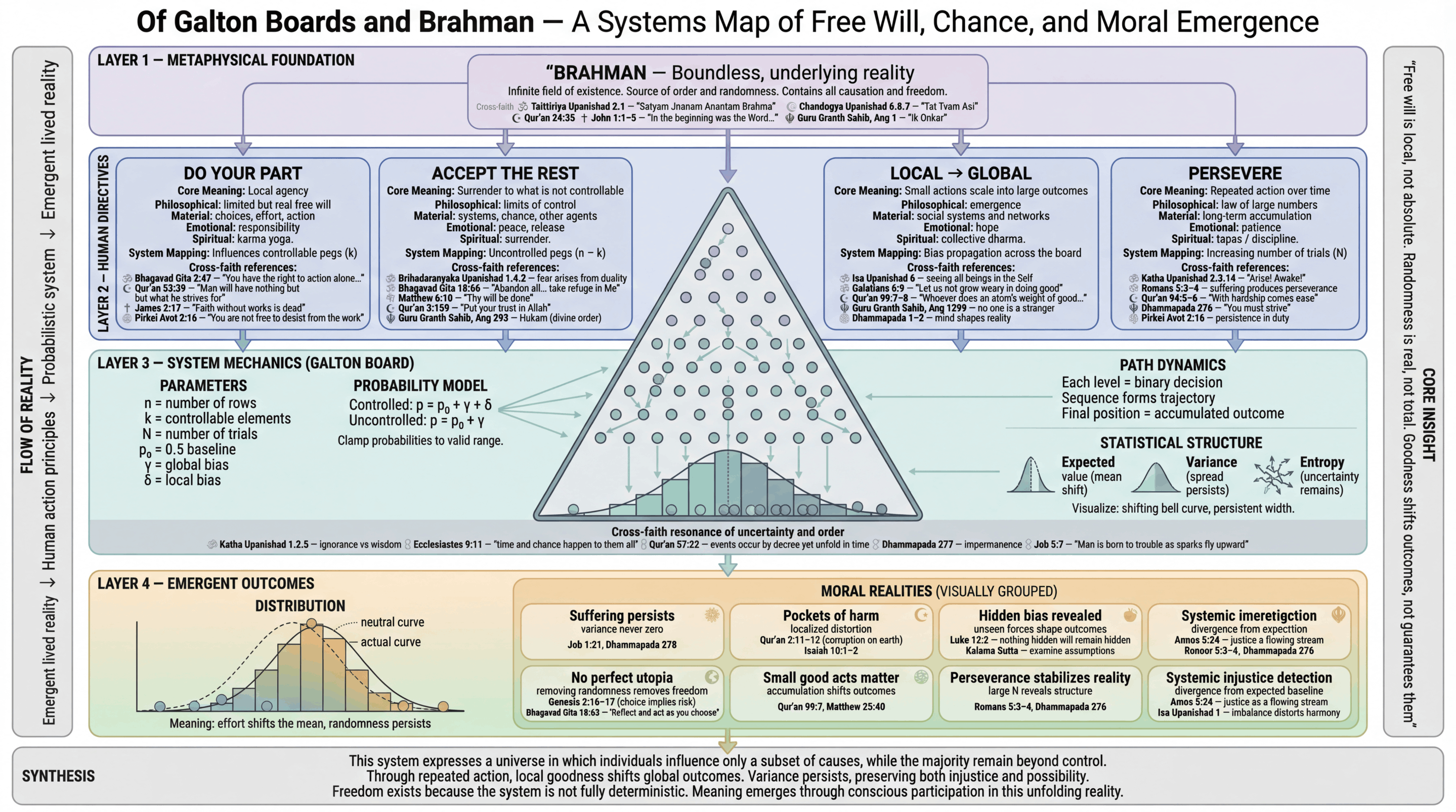
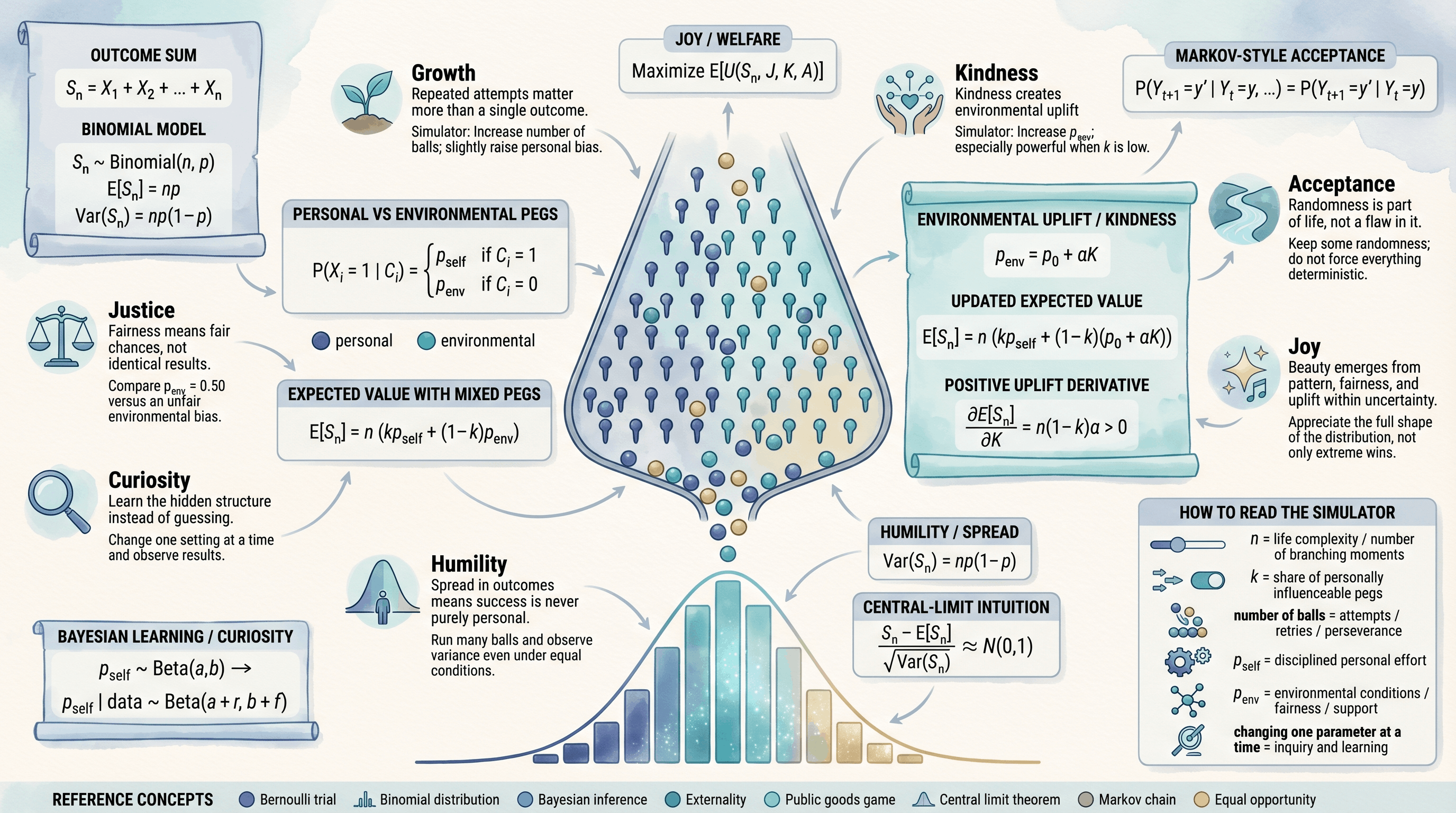
The Galton board turns life into a simple model: each ball is an attempt, each peg is a branching event, and each final bin is an outcome. The mathematics does not prove the seven principles as moral truths, but it does show how they fit naturally into probability, learning, fairness, and collective uplift.
The core model
Let each life path contain n branching events. At event i, the path moves right if Xi = 1 and left if Xi = 0. The final outcome is the total number of right moves:
Sn = X1 + X2 + ... + Xn
In the simplest case, each peg is a Bernoulli trial with probability p of going right, so:
Sn ~ Binomial(n, p), E[Sn] = np, Var(Sn) = np(1-p)
In your richer model, some pegs are personally influenced and some are environmentally influenced. If Ci = 1 means “personal peg” and Ci = 0 means “environmental peg,” then:
P(Xi = 1 | Ci) =
{ pself if Ci = 1; penv if Ci = 0 }
If a fraction k of pegs are personal, then the expected outcome becomes:
E[Sn] = n ( k pself + (1-k) penv )
To model kindness as collective uplift, let the environment improve with prosocial behavior K:
penv = p0 + αK
Then:
E[Sn] = n ( k pself + (1-k)(p0 + αK) )
This is the heart of the whole framework: effort matters, environment matters, randomness remains, and collective kindness can improve the environment through which everyone travels.
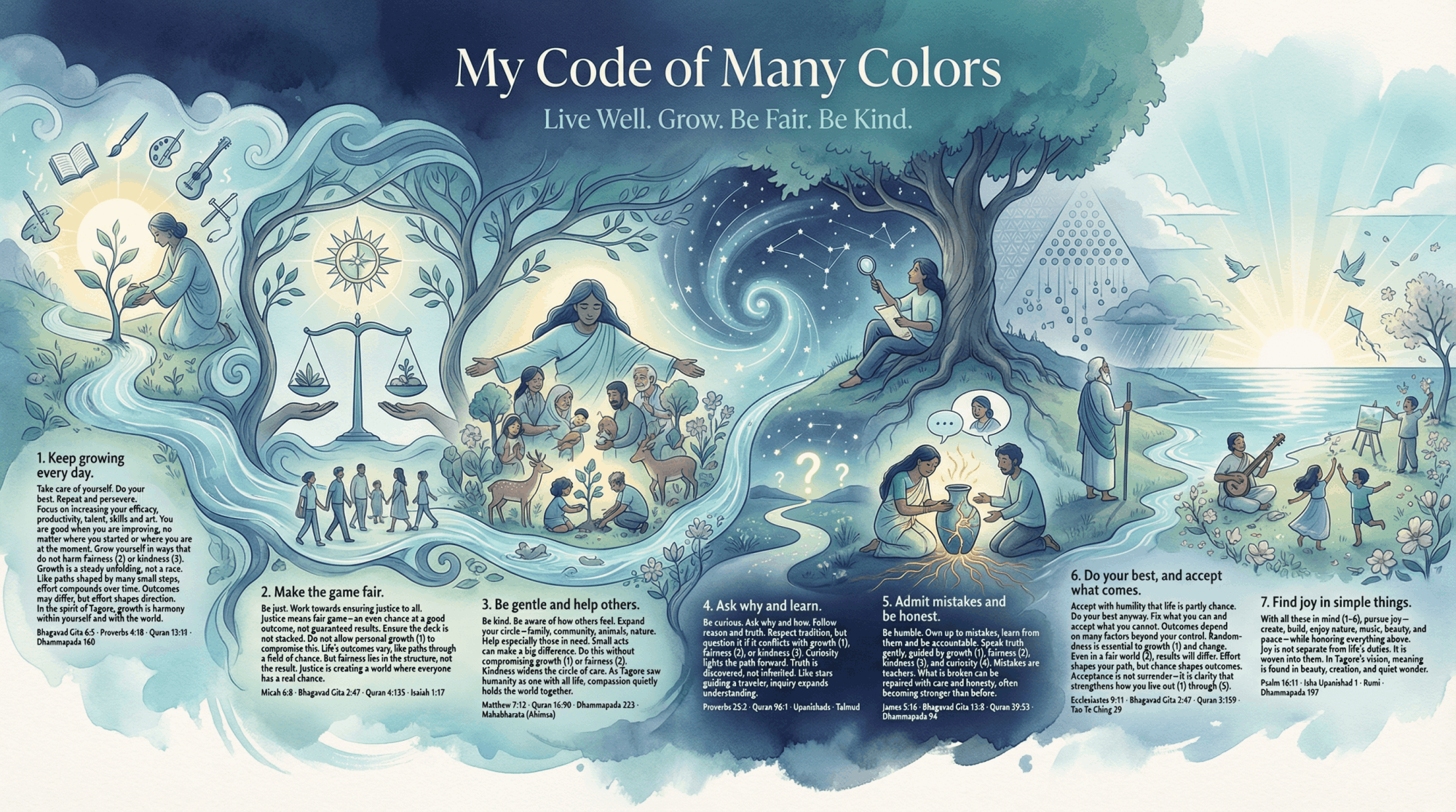
🌱 1. Growth
Growth appears as repeated trials. One outcome means very little; many attempts reveal structure. Improvement is not “one perfect ball” but the long-run effect of persistent tries through many branching events.
Sn = ∑ Xi
Mathematically, this is the logic of Bernoulli trials aggregated into a binomial process.
In the simulator: increase the number of balls to represent repeated attempts. Hold the environment steady, then change personal bias slightly upward and watch how persistence changes the distribution over time.
⚖️ 2. Justice
Justice is not equal outcome; it is fair generative conditions. What matters is whether the process gives people a fair chance rather than whether all balls end in the same bin.
E[Sn] = n ( k pself + (1-k) penv )
Fairness lives in the parameters and rules of the process, especially in whether environmental bias is unjustly tilted.
In the simulator: set both personal and environmental bias to 0.50 for a fair baseline. Then shift environmental bias away from 0.50 while keeping personal bias unchanged; that models a deck being stacked even when people try equally hard.
🤝 3. Kindness
Kindness is more than sentiment. In the model, it improves the environment faced by others. Small supportive actions add up into a system-wide uplift.
penv = p0 + αK
∂E[Sn] / ∂K = n(1-k)α > 0
If collective kindness rises, expected outcomes rise wherever environment matters. That is positive externality in human form.
In the simulator: model kindness as an improvement in environmental bias toward fairness or uplift. Increase penv modestly, especially when k is low. This shows how doing our part helps lift others whose paths depend heavily on circumstance.
🔍 4. Curiosity
Curiosity means learning the hidden parameters of the world rather than assuming you already know them. Good judgment comes from updating beliefs after seeing outcomes.
pself ~ Beta(a, b) → pself | data ~ Beta(a+r, b+f)
This is the Bayesian idea: observe, update, refine.
In the simulator: run several settings and compare the resulting histograms rather than trusting one guess. Ask: is the spread being driven by personal bias, by environmental bias, or by the share k of personal pegs?
🪞 5. Humility
Humility follows from variance. Even under the same rules, outcomes spread. A strong result may reflect merit, luck, environment, or some combination; so may a weak result.
Var(Sn) = np(1-p)
(Sn - E[Sn]) / √Var(Sn) ≈ N(0,1)
The central-limit effect explains why outcomes cluster yet still vary widely.
In the simulator: run many balls with the same settings. Even in a fair process, some balls still land far from the center. That visual spread is a reminder not to over-interpret single outcomes.
🍃 6. Acceptance
Acceptance is not passivity. It is recognizing that randomness is built into the path. Uncertainty is not a bug in life; it is part of how diversity, surprise, and resilience arise.
P(Yt+1 = y' | Yt = y, ...) = P(Yt+1 = y' | Yt = y)
A Markov view says each step moves probabilistically from the current state. You influence the path, but you do not fully control it.
In the simulator: keep some randomness in the system. Do not eliminate all variation. Watch how outcomes still differ even when biases are held constant; that is the visual language of acceptance.
✨ 7. Joy
Joy appears when we stop asking the world to be perfectly predictable and instead learn to appreciate pattern, beauty, emergence, and shared uplift within uncertainty.
Maximize E[U(Sn, J, K, A)]
In words: a good life is not just a high score. It is a life where outcome, justice, kindness, and peace can coexist.
In the simulator: do not focus only on pushing all balls to one extreme. Also look at beauty in the distribution itself: the shape, the spread, the effect of fairness, and the way small improvements in environment can help many paths at once.
🧩 The whole system
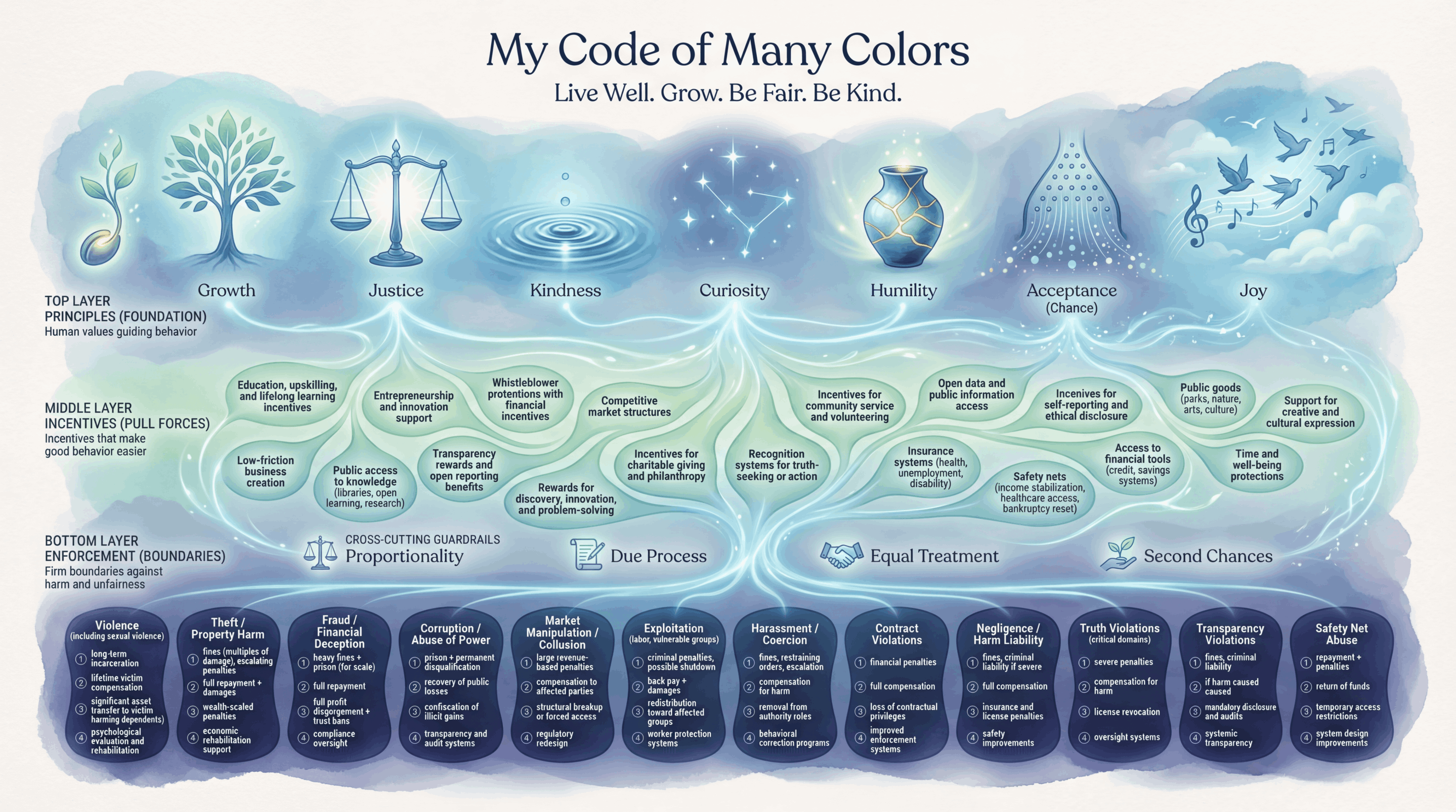
The seven principles fit together as one stochastic model of life:
Outcome = effort + environment + chance
E[Sn] = n ( k pself + (1-k)(p0 + αK) )
Personal effort improves what you can influence. Justice improves the rules. Kindness improves the environment. Acceptance respects randomness. Joy finds meaning in the whole.
In the simulator: experiment with all five knobs together: total pegs n, personal peg share k, attempts, personal bias, and environmental bias. That is your living model of the Code of Many Colors.
How to read the simulator through the code
A practical way to use the simulator is to treat n as life complexity, k as how much of the path is personally influenceable, personal bias as disciplined effort, environmental bias as structural conditions, and number of balls as persistence over time. That lets one see not only how individuals act within a world, but how a world can be made kinder and fairer by collective behavior.
🌱 More balls = perseverance
⚖️ penv near 0.50 = fairer world
🤝 Higher penv = environmental uplift
🔍 Changing one knob at a time = inquiry
🪞 Spread remains = humility
🍃 Randomness remains = acceptance
✨ Pattern plus uplift = joy